

Words That Make Science Click Part 1
Identifying Tier 3 and Tier 2 Vocabulary

Welcome back to the Words That Make Science Click Series!
If you missed the Introduction, you can find it here:
For Part 1, I am going to go over how to identify Tier 3 and Tier 2 words. Later in the series, I am going to explain how to teach Tier 3 and Tier 2 words in a science classroom.
In my previous blog post, I described how my students’ interpretation of the word increase hindered their understanding of periodic trends. Students interpreted the word increase in the same way they often use it in their everyday experiences:
The number of students in the class increased this year.
The amount of money in the account increased.
The number of cars on the road increased during rush hour.
Students came to the conclusion that increase describes quantity (more of something) rather than magnitude (larger in size). Hence, when I explained that the “size of the atom increases,” they interpreted it as “there are more atoms” instead of “the atom is larger.”
This classroom example demonstrates the complexity of language. Language grows and changes through social interactions, cognitive needs, and history. This is the reason why we often use the same word in many different ways and while there is beauty in language reflecting the complexities of human thought and experiences, it can hinder student understanding if not taken into consideration when coming up with science explanations for instruction.
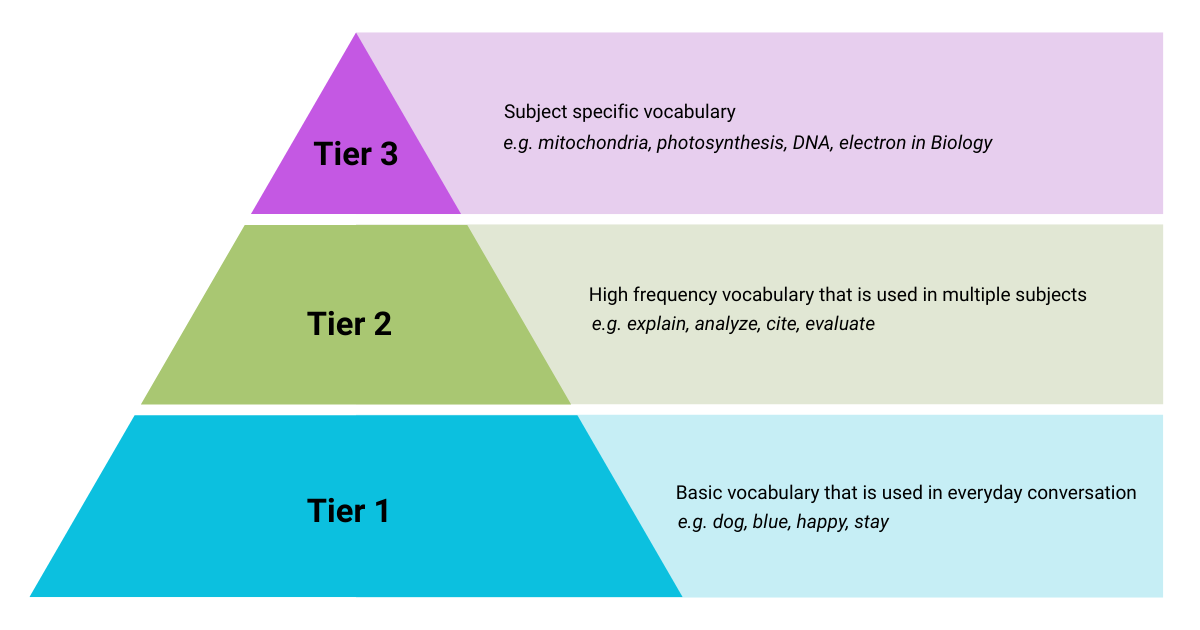
A systematic way of approaching this problem is by first identifying Tier 1, Tier 2, and Tier 3 words. This would help guide us into making coherent science explanations.
Photosynthesis Example
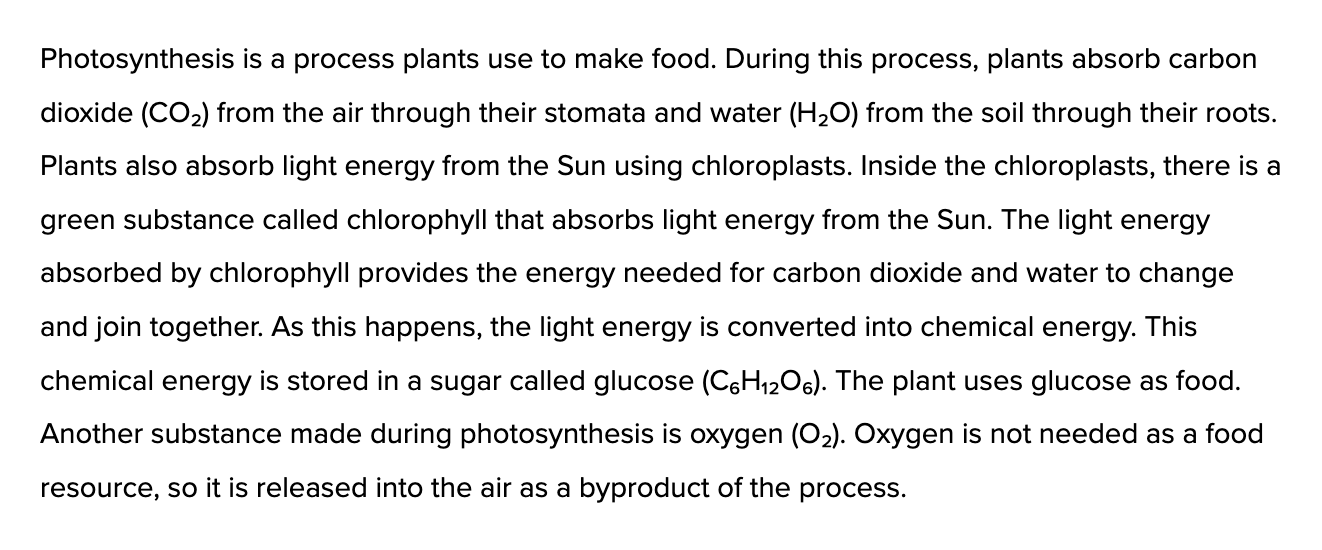
To demonstrate, I will be using a photosynthesis passage as an example:
Identifying Tier 1 Words
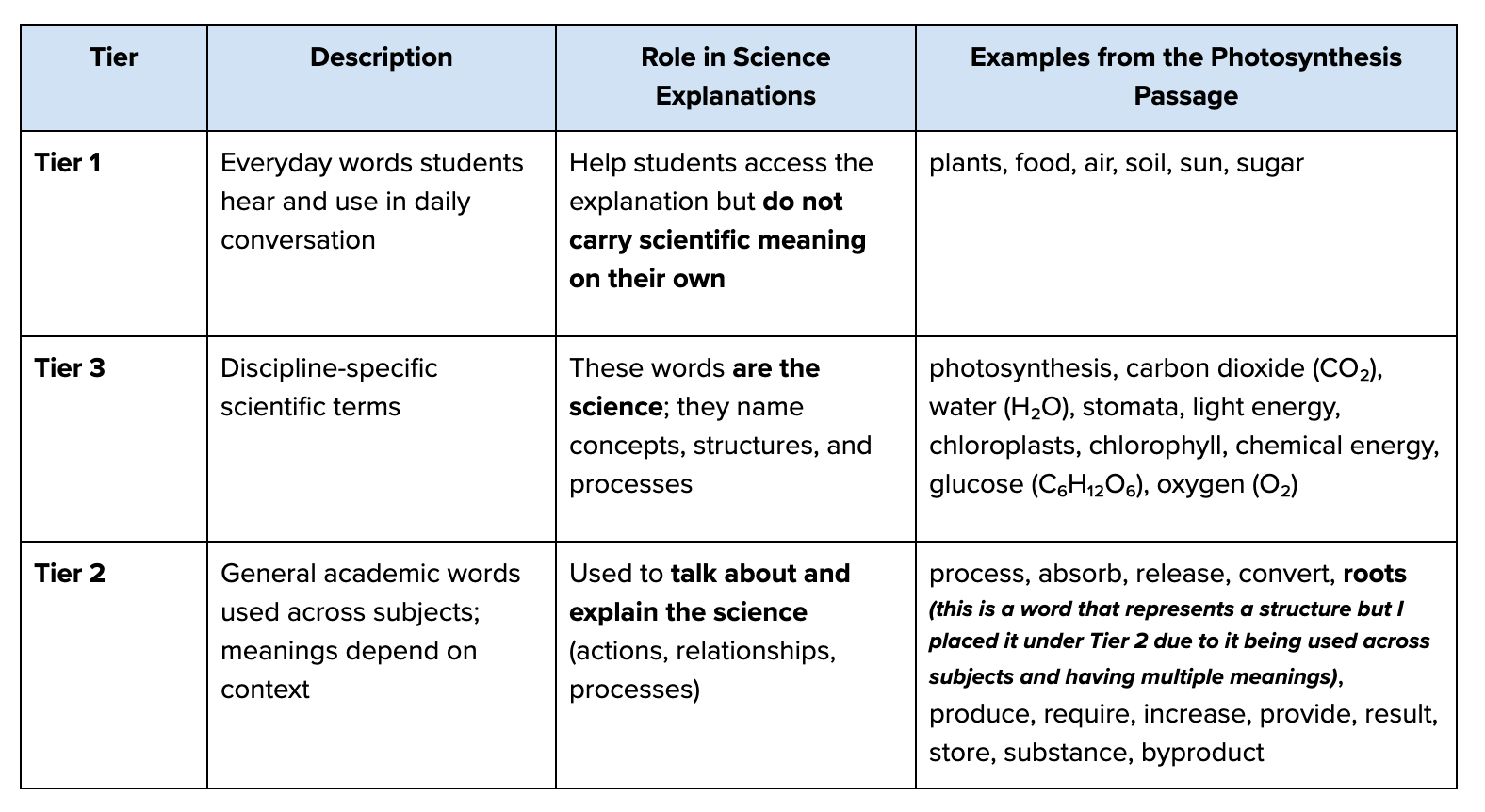
Tier 1 words are words that are used in everyday conversations. Students encounter these words on an almost everyday basis so they tend to have a strong understanding of these terms. Consequently, we do not need to explicitly teach them.
Here are some Tier 1 words that students may already be familiar with in the photosynthesis passage:
Plants
Food
Air
Soil
Sun
Sugar
Identifying Tier 3 Words
In science, Tier 3 words are used to describe the what. They are words that are the science. Tier 3 words are highly specific to a subject and are rarely found outside of it.
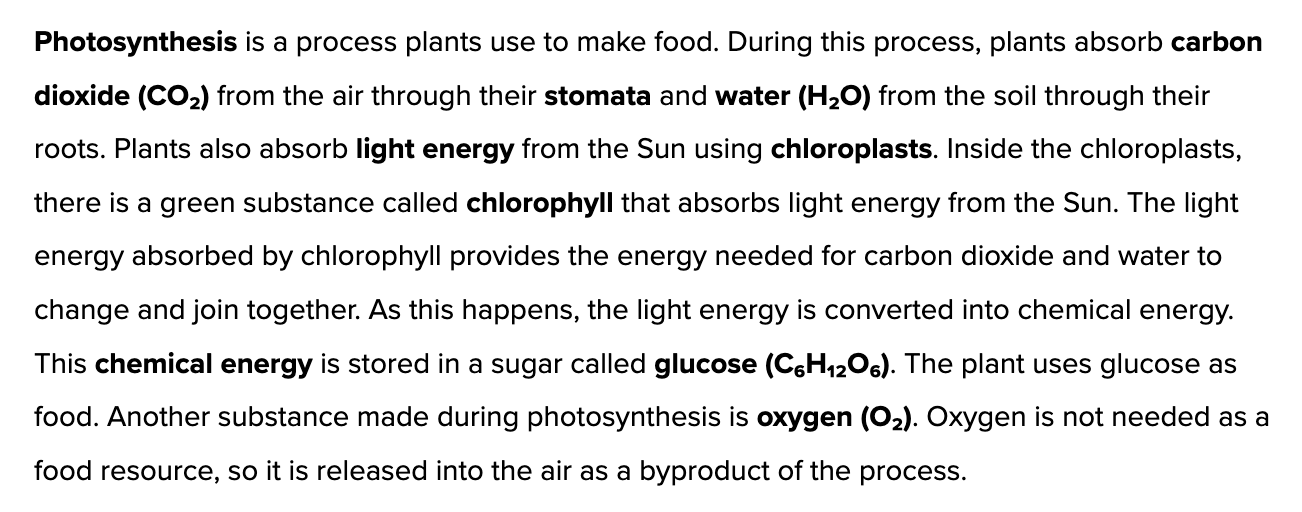
Here are Tier 3 words that can be found in the photosynthesis passage:
Photosynthesis
Carbon dioxide (CO2)
Water (H2O) - I put this under Tier 3 because of the chemical formula
Stomata
Light energy
Chloroplasts
Chlorophyll
Chemical energy
Glucose (C6H12O6)
Oxygen (O2) - I put this under Tier 3 because of the chemical formula
I have bolded the Tier 3 words in the passage:
Identifying Tier 2 Words
The reason why we identified the Tier 3 words first is to easily identify Tier 2 words.
In science, Tier 2 words tend to be used to talk about the science. There are exceptions, but that tends to be the pattern I see.
But more specifically, Tier 2 words are general academic terms that may be used across all subjects and usually have multiple meanings. Using the correct meaning depends on the context that they are used.
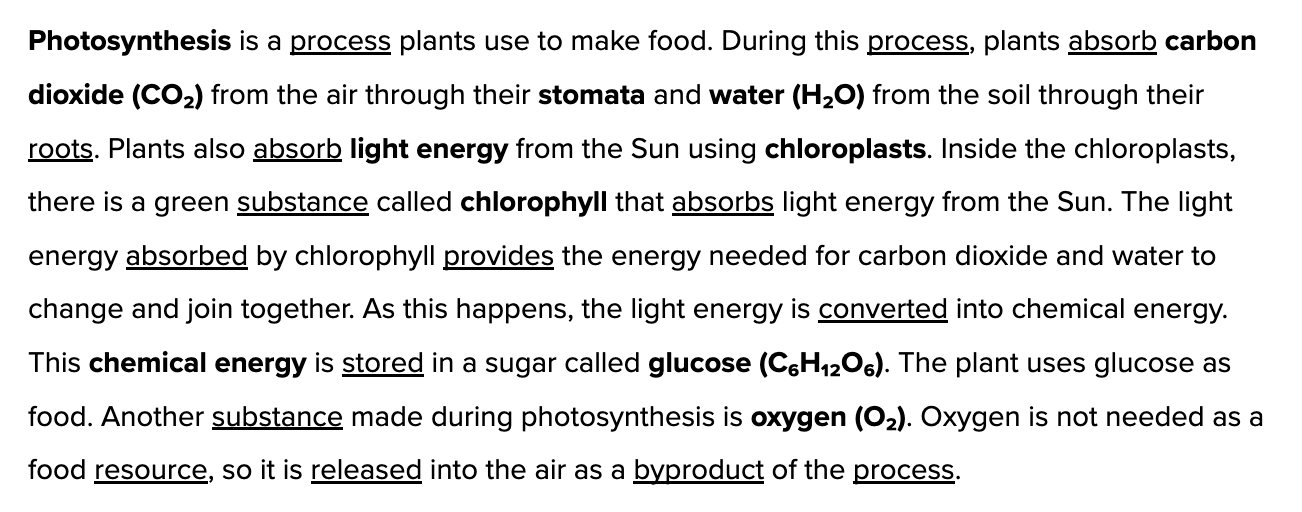
Tier 2 words are underlined below.
Summary of Tier 1, Tier 2, and Tier 3 Words
Why It’s Important To Identify Tier 3 and Tier 2 Words
As you can see, there are many Tier 3 and Tier 2 words packed closely together in the photosynthesis passage:
Tier 3 words such as photosynthesis, carbon dioxide, stomata, etc. are the science. In contrast, Tier 2 words such as process, absorb, substance, converted, etc. tend to talk about the science.
When it comes to teaching vocabulary, teachers mostly focus on Tier 3 words. Teaching Tier 3 words makes sense since students only encounter them within a specific subject and it is assumed that students have not come across these words before.
In contrast, teachers tend to dismiss teaching Tier 2 words because we assume that students are familiar with these terms already. Especially when they get to secondary. However, students might not know the meanings behind Tier 2 terms which can hinder understanding. This is especially true if students are grade levels behind in reading or are in the beginning stages of learning the English language.
For example, if students do not fully understand what the word process means, they might think that photosynthesis is a single reaction rather than a series of steps. As a result, students might interpret photosynthesis as inputs and outputs (carbon dioxide goes in, oxygen goes out) instead of understanding how energy is transformed and stored across multiple stages.
Tier 2 words also carry multiple meanings. So a student may be familiar with a Tier 2 word but might not use the correct meaning in the science context.
For example, the word substance is a Tier 2 word that means a type of material that can be made. However, based on everyday experience, the student might relate the word substance with the phrase “substance abuse.” Instead of interpreting substance as something that can be made, the student may believe that the word substance is synonymous with the word “drug” when used to describe photosynthesis. This can confuse students about what plants are actually making during photosynthesis.
So how do we teach vocabulary in a way that leads to conceptual understanding? The answer to this question depends on whether the word is Tier 3 or Tier 2. They each serve different purposes and teaching practices must be designed to reflect those differences. It is also important to determine how Tier 3 and Tier 2 words are aligned in the science explanation to determine the context students need to understand the scientific concepts and relationships being described.
This is why it is important to identify Tier 3 and Tier 2 words first.
AI Prompt
Identifying and aligning Tier 3 and Tier 2 words can be time consuming but you can use AI to cut the workload. I have provided an AI prompt that will help you identify and align Tier 3 and Tier 2 words and display them nicely on a table just like the one you see below. Copy and paste the prompt and then upload the science passage you plan to use. Click here to access the AI prompt.
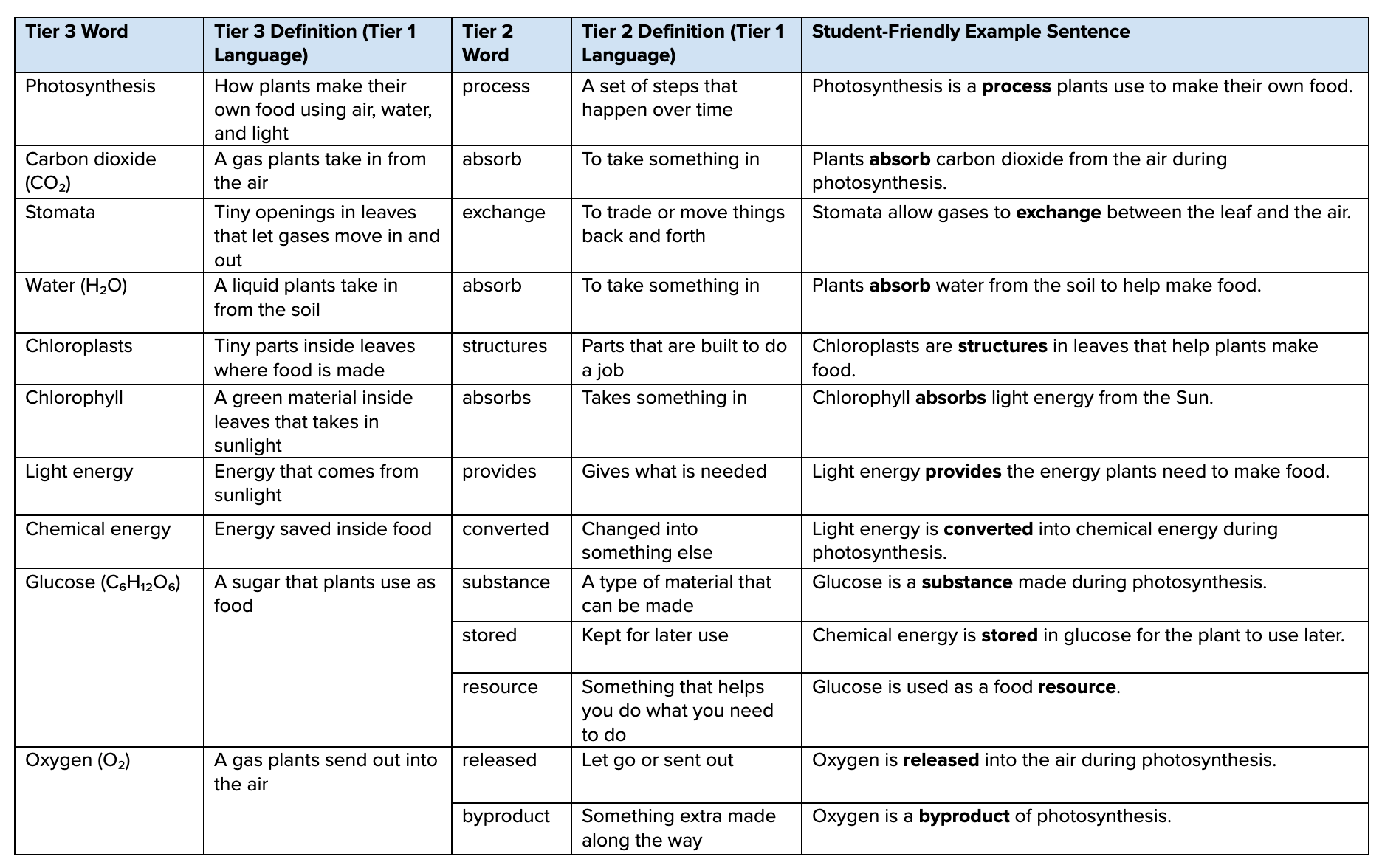
Side Note: While AI does cut the workload, I still like to go over it for accuracy and use my professional judgment to make adjustments. I have made a few adjustments on the table compared to the original output made by AI. Please do the same.
Final Thoughts
Identifying Tier 3 and Tier 2 words is the first step in providing meaningful vocabulary instruction.
In Part 2 of the series, I will go over how to teach Tier 3 words in the science classroom. Then, in Part 3, I will go over how to teach Tier 2 words in the science classroom.
Side Note: I wanted to express gratitude to Karen Vaites for giving me constructive feedback on identifying Tier 2 and Tier 3 words. Adjustments have been made on this post based on this feedback.
I love this so hard. Important that we talk in exemplar terms, just as you have here.
I would call "roots" a tier 2 word, because of the portability of "root" and 'rootedness" across domains. Just sharing to push the conversation.
Looking forward to Psrts II and III!